
Forecasting Icing Before It Impacts Wind Power
November 4, 2026 6:19 pmWhen wind is available, turbines are expected to produce. But during icing conditions, that relationship can change dramatically.
Ice accumulating on turbine blades can reduce power production, creating a gap between expected and actual generation. For energy traders, this means an increased risk of underproduction and potentially higher imbalance costs since there is a higher probability of underproduction on the market as a result of icing on neighbouring farms. For system operators, icing adds another source of uncertainty to an already weather-dependent power system.
The challenge is therefore not only to recognise icing once production has already fallen. It is to forecast its impact before it happens.
That is the focus of ENFOR’s improved icing forecasting module.
Why icing presents a particular forecasting challenge
Wind power forecasts translate expected meteorological conditions into expected production. Icing introduces another layer.
During an icing event, available wind does not necessarily translate into the production predicted by a normal power curve. Ice on the blades can reduce the effective production capacity of the turbine, sometimes substantially, even when the underlying wind conditions remain favourable.

This creates a particular forecasting challenge because the production loss is associated with the presence and severity of icing, rather than simply the available wind resource.
For traders, an overestimated production forecast can leave a portfolio short in the market. For system operators, unexpected reductions in wind production introduce additional uncertainty into the expected generation balance.
From detecting icing to forecasting icing
ENFOR’s improved WindFor Icing Forecasting Module is designed around two complementary capabilities:
- Detect icing when it occurs and adjust the power forecast accordingly.
- Forecast icing before the event starts, allowing its expected impact to be reflected in the power forecast in advance.
The second capability represents an important step forward.
The improved model has been evaluated using an extensive dataset covering 40 wind sites affected by icing over seven years, including meteorological variables such as temperature, relative humidity, wind speed and wind direction.
Improving forecasts where icing matters most
Not every wind farm has the same exposure to icing. The benefit of an icing-specific forecasting model therefore depends strongly on the characteristics and location of each site.
During the icing season, a comparison of day-ahead forecasts with a standard wind power forecast without an icing module shows the following indicative results:
- Medium-icing sites (~15% of hours with icing): 10-20% reduction in RMSE.
- Heavy-icing sites (~25% of hours with icing): up to 30% reduction in RMSE.
Where icing is a recurring cause of production losses, however, incorporating its expected effect can significantly improve the representation of actual wind farm production.
This reduction in the Day-Ahead forecast error when the imbalance costs can be higher represents significant savings for energy traders.
More than an icing warning
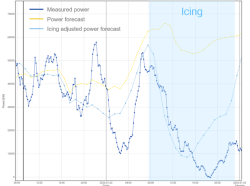
The purpose of the module is not simply to provide an alert when icing conditions are expected. The icing model is integrated into the power forecasting process so that its expected impact is reflected directly in the predicted production.
Thus, the improved Icing Forecasting Module provides the following outputs:
- An icing-adjusted power forecast
- A forecast of the expected icing effect
The image below shows the icing forecasting module in action for one of its use cases, avoiding a big deviation from the measured power.
The module also improves modelling outside the icing season by excluding icing effects from model training. This helps the model learn the relationship between weather conditions and power production without being distorted by icing-related losses, providing a clearer basis for forecasting when icing is not present.
The module also supports and provides value for new wind farms without an established site-specific icing history, making it particularly relevant for newly commissioned sites. An initial model can be used before sufficient site-specific icing observations have accumulated. As more observations of icing events become available, a site-specific icing model can then be established.
Why this matters for traders and system operators
The commercial impact of icing is straightforward: if the forecast expects more wind production than is actually delivered, the resulting deviation can increase imbalance exposure and costs.
Being able to anticipate icing changes the information available to energy traders.
Instead of waiting for production measurements to reveal that a wind farm is already affected, expected icing losses can be incorporated into the power forecast beforehand. This provides a more realistic expectation of the energy that may actually be available to the market.
For system operators, improved forecasts of icing-related production losses can similarly provide a more accurate picture of expected renewable generation. As wind power becomes an increasingly important part of electricity systems, understanding weather-related production constraints becomes increasingly relevant to maintaining an accurate view of the generation balance.
There is also a portfolio effect. Icing can introduce a systematic tendency to overestimate wind production during affected winter periods. Reducing that site-level bias can become particularly valuable when forecasts from multiple wind farms are aggregated into a larger portfolio.
Winter weather cannot be avoided. Its impact on your forecast can be anticipated.
Is icing affecting your wind power forecasts?
Contact ENFOR to learn more about how icing-adjusted forecasting can help improve the accuracy of your wind power forecasts during winter conditions.